This journey is just the beginning. For those who want to go deeper, it leads to Nan Jaden Amoni, a work of Haitian Kreyòl literature by Marleen Julien. Classic fables and original stories, in authentic Kreyòl. Available now. Find out more in Week 5.

Week 2 · May 8–14

Revolisyon Ayisyen

The Haitian Revolution was not just a fight for independence. It was a fight to prove that enslaved people had the right to be free, to govern themselves, and to be seen as fully human. This week, we honor the leaders, women, dates, and memories that helped give birth to Haiti.

Vwayaj la
0 / 5
🥣

Èske W Te Konnen? · Did You Know?

Soup Joumou Is a Freedom Food

Soup Joumou Se Manje Libète

Soup Joumou is not just a traditional dish — it is a symbol of Haiti's independence, dignity, and resilience. UNESCO added it to the Representative List of the Intangible Cultural Heritage of Humanity in 2021, recognizing it as a living act of memory eaten every January 1st to honor freedom.

📖 UNESCO Intangible Cultural Heritage · 2021

Under slavery, pumpkin soup was reserved for the French colonists — enslaved people were forbidden to eat it. On January 1, 1804, the day Dessalines declared independence, Haitians ate Soup Joumou for the first time as a free people. The soup that had been a symbol of exclusion became a symbol of liberation.

More than two centuries later, Haitian families everywhere — in Haiti, in the diaspora — still serve Soup Joumou every January 1st. It is not just breakfast. It is memory in a bowl. UNESCO's 2021 recognition honored Soup Joumou as a living tradition that carries the meaning of freedom forward, generation after generation.

Tap to mark as seen

Dat Kle yo · Key Dates

1740–1758

François Makandal

18-year underground resistance using African spiritual knowledge. The French burned him at the stake.

August 14, 1791

Bwa Kayiman

Ceremony associated with Boukman and Cécile Fatiman — remembered as the spiritual ignition of the Revolution.

May 18, 1803

Drapo a fèt

Catherine Flon sews the Haitian flag — the white is removed forever.

November 18, 1803

Batay Vètyè

The decisive battle led by Dessalines — Napoleon's army is defeated, opening the door to independence.

January 1, 1804

Endepandans

Dessalines declares Haiti free — the world's first Black republic.

Lidè Revolisyonè yo · Revolutionary Leaders

Toussaint Louverture

Military Genius · The Black Napoleon

Defeated Spanish, British, and French forces. Last words: "In overthrowing me you have done no more than cut the trunk of the tree of Black liberty. It will spring back from the roots."

Jean-Jacques Dessalines

Founder of Haiti · Emperor Jacques I

Declared independence January 1, 1804. Restored the Taíno name Ayiti. Trained by Grann Tòya (Victoria Montou), a warrior woman.

Henri Christophe

King of Northern Haiti · Builder of the Citadelle

Built the Citadelle Laferrière — the largest fortress in the Western Hemisphere — to defend against French return. Now a UNESCO World Heritage Site.
Tap to mark this chapter complete

Jou Enpòtan yo · Important Dates

The Calendar of a Nation

Ayiti gen anpil dat ki pote memwa pèp la, soti nan endepandans rive nan lang ak liberasyon. Chak dat ede nou sonje kote nou soti ak sa pèp la pote.

Haiti's calendar carries the memory of a people. These are the dates tied to the Revolution, the founding of the nation, and the language Haitians chose to keep.

1 Janvye · January 1

Endepandans

Independence Day. Dessalines declared Haiti free in 1804. This day is also inseparable from Soup Joumou — the pumpkin soup once forbidden to enslaved people, now eaten by every Haitian as an act of dignity and memory. UNESCO recognized this tradition in 2021.

2 Janvye · January 2

Fèt Zansèt yo · Ancestors' Day

A day to honor the women and men who fought, suffered, and sacrificed so Haiti could become free. It reminds us that independence was not only declared. It was carried by generations of ancestors.

18 Me · May 18

Fèt Drapo ak Inivèsite · Flag Day & Universities' Day

One of Haiti's biggest patriotic holidays. It honors the day Catherine Flon is remembered for sewing the Haitian flag in 1803, symbolically removing the white from the French tricolor and creating a new image of freedom. The day also honors universities and education. Haitian Heritage Month is celebrated in May partly because of this date.

14 Out · August 14

Jounen Bwa Kayiman · Bois Caïman Day

Commemorates the historic Bwa Kayiman ceremony of 1791, associated with Boukman and Cécile Fatiman. It is remembered as the spiritual ignition of the Haitian Revolution. Days later, the uprising spread across the North. This day holds deep cultural and historical meaning.

20 Septanm · September 20

Jou Desalin · Dessalines Day

Honors Jean-Jacques Dessalines — the man who declared independence, restored the Taíno name Ayiti, and built the first Black republic from the ground up. A founding figure of the nation.

18 Novanm · November 18

Batay Vètyè · Battle of Vertières

The final and decisive battle of the Haitian Revolution, 1803 — the defeat of Napoleon's forces that made independence six weeks later possible. Vertières is where the last door to freedom was pushed open.

Tap to mark this chapter complete
Fanm Revolisyonè · Revolutionary Women

The Women Who Made Haiti Free

These women did not simply support the Revolution. They helped make it possible. Too often, history left them in the margins. Here, we bring them back to the center.

Grann Tòya

Bambara Warrior · Godmother of Dessalines

A Bambara warrior woman who trained the young Dessalines in combat and became his godmother. Without Grann Tòya, there may have been no Dessalines as history knows him.

Cécile Fatiman

Manbo · Bwa Kayiman

A Vodou priestess associated with the Bwa Kayiman ceremony of August 1791, remembered as one of the spiritual sparks of the Revolution. Haitian memory holds her as one of the women who helped call a people toward freedom.

Sanite Bélair

Revolutionary Warrior · Lieutenant

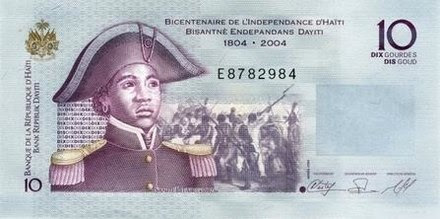
At 21, she refused a blindfold before execution — facing the firing squad with open eyes. Her face appears on the Haitian 10 Gourdes banknote.

Marie-Jeanne Lamartinière

Soldier · Battle of Crête-à-Pierrot

Dressed as a soldier, rifle in hand, she charged French lines at Crête-à-Pierrot in 1802 — inspiring every fighter around her.

Dédée Bazile

Défilée · Act of Revolution

After Dessalines was assassinated, Dédée Bazile gathered his remains and carried them to burial. Some called her "la folle," but her act was one of love, courage, and memory.

Catherine Flon

Godmother of the Flag

Dessalines' goddaughter who sewed the first Haitian flag by removing the white stripe from the French tricolor — a single act that redefined a nation's identity forever.
Sanite Bélair on the Haitian 10 Gourdes banknote, bicentennial edition

10 Goud · Bisantnè Endepandans Dayiti, 1804–2004

Sou lajan peyi a · On the National Currency

Sanite Bélair on the 10 Gourdes

Sanite Bélair appears on the Haitian 10 Gourdes banknote, issued in the bicentennial edition that marked 200 years of independence. At 21, she refused a blindfold before her execution and faced the firing squad with open eyes.

Her face on the country's currency is a daily reminder. Every time a Haitian holds this bill, they hold a piece of the woman who chose to die looking freedom in the eye.

Tap to mark this chapter complete

💡 Grammar Spotlight

Kijan pou w make vèb yo an kreyòl · How to Mark Verbs in Kreyòl

Small words do the heavy lifting

Kreyòl uses marker words BEFORE the verb — no verb conjugation needed.

KreyòlEnglish
tepast — "Yo te goumen." (They fought.)
apnow — "N ap aprann." (We are learning.)
pralfuture — "Yo pral lib." (They will be free.)
panot — "Mwen pa bliye." (I do not forget.)

In everyday Kreyòl, "nou ap" often becomes "n ap."

Dessalines te deklare endepandans.

Dessalines declared independence.

Nou pa bliye zansèt nou yo.

We do not forget our ancestors.

🎯 te = past · ap = now · pral = future · pa = not. Four words unlock four tenses.

Jwèt Pou Ou · Revolution Quiz

Test Your Knowledge

Loading quiz...

🇭🇹

Felisitasyon! Ou fini Week 2.

You walked the Revolution from Bwa Kayiman to Endepandans. You learned the dates, met the women, and heard the language carry it all. Continue to Week 3 when you're ready.

Mo Revolisyon an · Words of the Revolution

Words of the Revolution

8 words that defined the Haitian Revolution — learn to say them, understand what they cost.

Vire Mo Yo · Tap to flip — hit Listen on the back

Revolisyon

Tap to flip

Revolution

The Haitian Revolution (1791–1804) was the uprising of enslaved people that led to the founding of an independent nation...

Libète

Tap to flip

Freedom / Liberty

The goal of every revolution. Haiti chose freedom over comfort — and paid for it...

Endepandans

Tap to flip

Independence

Declared January 1, 1804 by Dessalines. Haiti was the first Black republic in th...

Drapo

Tap to flip

Flag

The flag Catherine Flon sewed on May 18, 1803. Blue and red — unity and strength...

Rezistans

Tap to flip

Resistance

18 years of resistance led by Makandal before the Revolution even began.

Zansèt

Tap to flip

Ancestors

Those who fought before us. In Haitian culture, ancestors are present — not past...

Batay

Tap to flip

Battle / Fight

The many battles — Crête-à-Pierrot, Vertières — that secured Haitian freedom.

Nanm

Tap to flip

Soul / Spirit

What cannot be enslaved. "Drapo sila a se nanm tout Ayisyen" — that flag is the ...

Continue your journey

Kontinye vwayaj ou · Continue the journey

You’re almost halfway. Keep going — there’s a giveaway at the end.

Finish Week 5 and pass the quiz by May 31 to be entered to win one of 10 signed copies of Nan Jaden Amoni. Plus a new fable from the second edition, published in Week 5 first.

✨ Continue to Semèn 3 →

The oral tradition that carried the names of Grann Tòya and Cécile Fatiman through generations is the same tradition that carries the fables in Nan Jaden Amoni. Stories are how Haitian memory survives.

🌿

Lakou Knowledge · Haitian Knowledge of the Land

Sitwonèl

Lemongrass

In many Haitian homes, sitwonèl grows near the door or in a corner of the yard — known, used, tended without ceremony. It represents a kind of knowledge that lives at home: passed from grandmothers to children, from observation to habit. Haitian plant knowledge is often quiet, practical, and deeply rooted in care.

What kinds of knowledge are learned at home rather than in school — and why do they matter just as much?

Pataje · Share:

FacebookX / TwitterLinkedInWhatsApp

Need Haitian Kreyòl language services?

Translation · Interpretation · Voice-Over · Cultural Consulting

📞 Book a Consultation 📝 Order Language Services

⚖️ Sajès · Wisdom

“Sa ou fè se li ou wè.”

What you do is what you see.

A strong Haitian ethical idea: our actions shape what returns to us. The revolution did not happen because people wished for freedom — it happened because people acted, sacrificed, and chose. What we do becomes the world we live in.

How do our actions shape the world we live in — and the world we leave behind?

Up next: Week 3

Week 3 is all about the Haitian flag, its colors, its creator, and what it means to be Haitian. Continue your journey now.

🔒 Unlocks May 15